
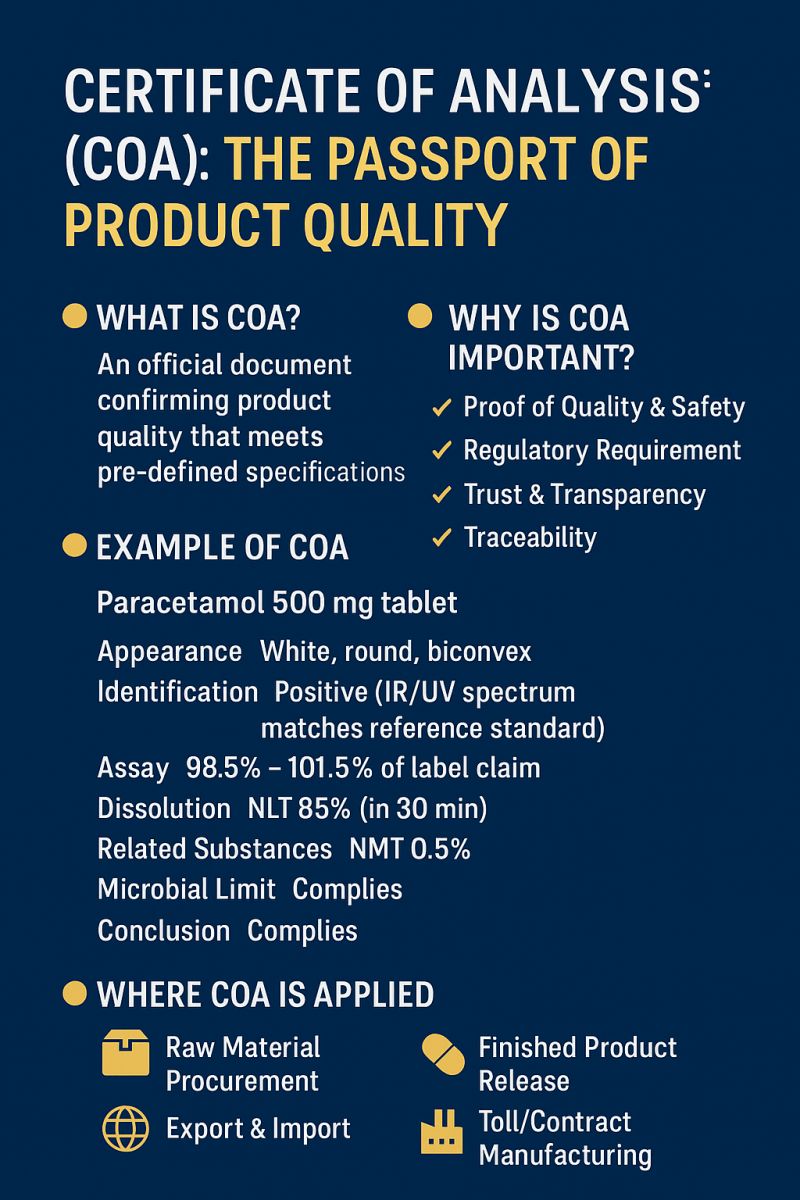
If you’ve spent any time in peptide research circles, you’ve seen the letters “COA” thrown around like a badge of honor. A vendor posts a PDF, calls it third-party tested, and buyers treat that as the seal of approval. After years of covering the supplement and research-chemical space, I can tell you it’s rarely that simple. A Certificate of Analysis is genuinely useful but only if you know what it’s supposed to contain, and only if you know how to tell a real one from a convincing fake.
Here’s what a legitimate peptide COA actually breaks down, why each section matters more than people assume, and how the more careful buyers in this space protect themselves from paperwork that looks official but isn’t.
The Three Things a Legitimate COA Actually Measures
A proper third-party COA isn’t a single number. It’s a report built around three distinct chemical metrics, each answering a different question about what’s actually in the vial.
1. Purity Percentage (HPLC Test)
This is the number most people jump straight to. High-Performance Liquid Chromatography (HPLC) separates the compounds in a sample and measures what fraction of the total powder is actually the target peptide, versus degradation products, synthesis byproducts, or other residue left over from manufacturing. Reputable vendors typically aim for purity in the 98–99% range. Anything meaningfully lower isn’t necessarily dangerous on its own, but it’s a signal of a rushed or lower-quality synthesis process.
2. Molecular Weight & Identity (Mass Spectrometry)
Purity only tells you how clean the sample is it doesn’t tell you what the sample actually is. That’s where mass spectrometry (MS) comes in. This test confirms the molecular weight and identity of the compound, verifying that the vial genuinely contains the peptide on the label rather than a cheaper substitute. This distinction matters a lot with newer, harder-to-synthesize multi-receptor peptides: a lab report confirming a compound’s identity is what stands between paying for a complex, expensive-to-produce molecule and unknowingly receiving something far simpler and cheaper.
3. Contaminant & Safety Screenings
This is the section that gets skipped over most often, and it’s arguably the most important one for anything intended for injection.
- Endotoxin Testing (LAL Test): This screens for bacterial cell wall fragments pyrogens left behind from the manufacturing process. These fragments don’t need to contain live bacteria to be dangerous; they can trigger severe immune responses, fever, or septic shock when introduced directly into the body.
- Heavy Metal & Solvent Screening: This checks for residual manufacturing chemicals, like heavy metals or harsh industrial solvents, that can be left behind in a poorly refined final product.
Taken together, these three categories are what separate a real COA from a marketing graphic with a purity percentage slapped on it.
Why COAs Matter So Much More for Peptides Than for Pills
It’s worth pausing on why this level of scrutiny exists in the first place. Oral supplements and pills pass through the digestive tract, where the body has multiple layers of filtration before anything reaches the bloodstream in meaningful concentration. Peptides don’t get that buffer. They’re typically injected directly into subcutaneous fat or muscle tissue, which means whatever is in the vial good or bad goes straight into the body.
That changes the stakes in three specific ways.
Invisible contaminants become a direct physical threat. Bacterial endotoxins and heavy metals can’t be seen, smelled, or tasted. There’s no sensory cue that something is wrong. Injecting a contaminated or non-sterile peptide can lead to local tissue necrosis, skin abscesses, systemic infection, or anaphylaxis outcomes that don’t show up until after the injection has already happened. In many ways, a clean endotoxin report matters more than a high purity percentage, because purity issues are typically about efficacy, while endotoxin contamination is about acute physical harm.
Substitution and fraud are a real, ongoing problem. Synthesizing complex, multi-receptor peptides is technically difficult and expensive to do correctly. That cost gap creates an incentive for less scrupulous manufacturers to substitute a cheaper, easier-to-produce peptide for a more complex one, or to dilute active ingredient with inert filler like mannitol powder. A mass spectrometry result on a COA is the piece of evidence that closes that loophole it proves, chemically, that the vial contains what the label says it does.
Dosing accuracy depends on knowing the actual quantity inside the vial. A label claiming “10 mg” is only meaningful if it’s true. If a vial actually contains less active peptide than advertised, the result is treatment failure the product simply doesn’t do what it’s supposed to. If it contains meaningfully more due to inconsistent manufacturing, the risk runs the other direction. A proper COA verifies the quantitative mass inside the vial, rather than asking buyers to take the label on faith.
The Big Catch: Not All COAs Are Real
Here’s the part that trips up even careful buyers. Having a COA PDF posted on a vendor’s website is not, by itself, proof of anything. In the less-regulated corners of the peptide market, falsified and misused lab reports are common enough that seasoned buyers treat every unverified COA with a healthy dose of skepticism.
A few of the tricks that show up repeatedly:
- Photoshop fraud – editing a legitimate old lab report with new dates, new batch numbers, or an inflated purity percentage.
- “Golden batching” – sending a single high-purity vial off for lab testing, then shipping an entirely different, lower-quality batch to actual customers.
- Stolen reports – copying and reusing a COA that was originally generated for a completely different company’s product.
None of these require much technical skill. A convincing PDF with a lab’s logo on it is often enough to satisfy a buyer who doesn’t know to look further.
How More Experienced Buyers Actually Verify a COA
The pattern among people who’ve been burned before – or who’ve simply done their homework – is fairly consistent. They don’t stop at “is there a COA.” They check two things:
- Does the report come from an accredited, independent third-party lab? Testing facilities like Janoshik Analytical have built reputations specifically around independent verification, meaning they have no financial stake in whether a given batch passes or fails.
- Can the report be verified directly through the lab, not just the vendor? Most reputable testing labs issue a unique report key, batch number, or QR code tied to that specific test. Checking that identifier against the lab’s own verification portal – rather than trusting the PDF a vendor happens to host – is what actually confirms the report is authentic and tied to the batch in question.
That second step is the one most buyers skip, and it’s the one that actually matters. A COA hosted on a vendor’s own site proves nothing about whether it’s genuine, current, or even related to the product being sold. A COA confirmed through the testing lab’s independent portal is a different thing entirely.
The Bottom Line
A real Certificate of Analysis is a genuinely useful document – when it’s real. It tells you three things a label alone never can: how pure the compound is, whether it’s actually the molecule it claims to be, and whether it’s free of the kind of contamination that turns a research compound into a medical emergency. But the existence of a COA-shaped PDF isn’t the same as proof. The only way to know a report is trustworthy is to trace it back to the lab that issued it and confirm it independently – not to take a vendor’s word that the document speaks for itself.
This article is for informational purposes only and does not constitute medical advice. Research peptides are not regulated for human consumption in most jurisdictions, and their use carries inherent risks regardless of documentation quality.
